Begin with three layers, not one event list
A national commemoration can look deceptively simple on a calendar. The date names what is remembered, but the way people encounter it changes with ceremonies, exhibitions, performances, broadcasts, and private reflection. Korea.net’s current headline makes that distinction visible: it reports cultural and artistic events in Seoul marking the 81st Liberation Day. The events mark the day; they are not the day itself.
Use three layers. The first is historical meaning: liberation is the reason for the observance. The second is public memory: people and institutions choose to remember together. The third is interpretation: organizers use a medium—music, visual art, performance, or another format—to bring that memory into the present. The approved source names the cultural and artistic frame but does not provide enough stored detail to inventory or review every program.
This separation prevents a common shortcut. A striking performance may become your strongest image of Gwangbokjeol, but its style belongs to one curatorial moment. It can open a route into the commemoration without becoming a complete definition of Korean historical memory.
Keep Gwangbokjeol visible in translation
Liberation Day is the clearest English orientation, but it should not make 광복절 or Gwangbokjeol disappear. Arirang News titles its English video with both the Korean name and the phrase the day of the restoration of light in Korea. That phrasing gives an English reader a conceptual doorway into the name while remaining a publisher’s title, not a complete etymological lesson.
The practical rule is simple: use Liberation Day to identify the occasion, then retain Gwangbokjeol when discussing how it is named and experienced in Korea. Translation is doing two jobs here. One label answers which holiday. The Korean name keeps the reader close to the local cultural frame.
Do not overload the phrase with claims the packet cannot support. The two records establish the holiday topic, the 81st-anniversary framing, a Seoul arts context, and an English viewing path. They do not establish every historical nuance, household response, political interpretation, or regional practice.
Read the art as a choice about memory
When a commemoration uses art, ask why that medium fits the memory being carried. Music unfolds in shared time. An exhibition asks viewers to move among selected objects or images. Performance places bodies, sound, and attention in the same space. These are analytical prompts, not claims about the specific 2026 lineup, which the approved record does not describe in detail.
Then ask what the format foregrounds. Does it invite quiet attention, collective feeling, historical sequence, or a conversation between generations? The answer should come from the actual work or program description, not from the holiday label alone. A cultural event gains meaning through the connection it builds; the occasion does not automatically tell you what every artwork means.
This is the guide’s first original insight: format is part of interpretation. The second is that visibility is selective. Public programs make some stories easier to encounter, but selection always leaves other experiences outside the frame. Appreciating the program and recognizing its boundary are compatible acts.
THREE LAYERS OF MEMORY
Move from name to public form
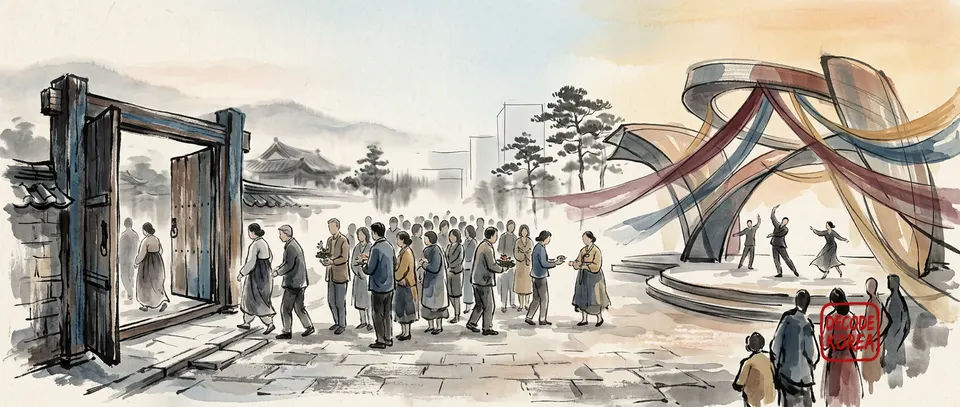
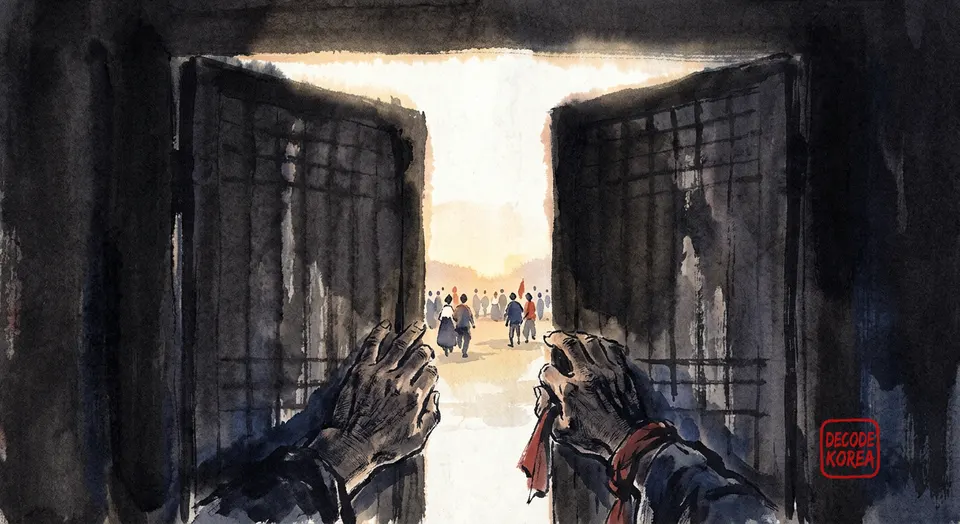
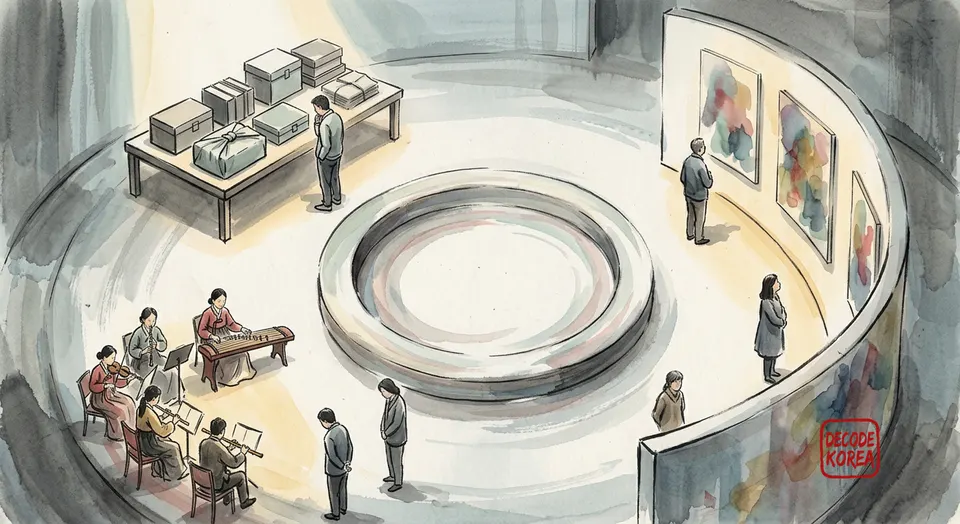
These original illustrations visualize the reading method; they do not reproduce a specific 2026 event, venue, artwork, or audience.
1 / 2
Source: Korea.net · Cultural, artistic events to mark 81st Liberation Day in Seoul · YouTube · Arirang News · [K-Culture in Photos] Gwangbokjeol: The day of the restoration of light in Korea
Use the Arirang video as orientation
Arirang News provides a current English-language route into the subject. Its approved record identifies Gwangbokjeol, Liberation Day, history, and video as the relevant topics, and its title explicitly presents the day through a K-Culture in Photos frame. That makes it useful for visual orientation and for hearing the Korean name in a publisher context.
The stored record is description-only. This article therefore does not quote narration, identify individual images, or treat the video as independent confirmation of details in the Korea.net event report. Two sources can strengthen an article while doing different jobs: the official report establishes the current Seoul arts frame; the broadcaster video supplies an English cultural entry point.
That distinction is also a reusable media habit. Before repeating a detail, ask whether it comes from a title, a description, a scene you verified, or a full transcript. Here, the answer stays at title-and-metadata level, so the claims stay there too.
 WATCH ON YOUTUBE[K-Culture in Photos] Gwangbokjeol
Open embedded player
See the framework in one named ceremony
The Korea Times reported that Seoul marked the 81st Liberation Day with a bell-ringing ceremony at Bosingak Pavilion, echoing the historic custom in which 33 dawn bell rings signaled the lifting of the capital’s nightly curfew. Nine descendants of independence activists, recommended by the Heritage of Korean Independence, took part—an example of public memory built through direct lineage rather than a general audience alone.
The report also named a specific historical object at the ceremony: a national flag discovered during 2009 renovations at Jingwan Temple, believed to date back to the 1919 independence movement. A city official was quoted saying the event should serve not only to reflect on the joy of liberation but also to pass down that history—language that makes the second and third layers of this guide’s framework concrete rather than abstract.
This single ceremony does not stand in for every 2026 Gwangbokjeol program. It is one independently reported example of how public memory (a specific gathering, specific participants) and artistic or ceremonial choice (bell-ringing, a preserved flag) combine to interpret the historical liberation being marked.
Carry the framework into the next commemoration
Start with the history being named. Then notice the public form of remembrance: a gathering, a ceremony, a broadcast, or a cultural program. Finally, examine the interpretive choice inside that form. What medium is being used, what does it foreground, and what remains outside its frame?
For Gwangbokjeol in 2026, the approved sources support a careful answer. The day is being marked in Seoul through cultural and artistic events, and an English Korean broadcaster is presenting Gwangbokjeol through a visual culture format. They show that remembrance is active and mediated, but they do not collapse history into programming.
That is the value of keeping the three layers distinct. History gives the commemoration its reason. Public memory gives it a shared present. Art gives one moment a form. Read together, they deepen one another; read as interchangeable, they flatten the day.
READ IN ORDER
History, memory, interpretation
Use the three questions in sequence when a current program marks a historical day.
- 01
History
Identify the event or turning point being remembered.
- 02
Public memory
Notice who is creating a shared form of remembrance and through what setting.
- 03
Interpretation
Ask what the selected artistic medium foregrounds and what it leaves outside the frame.
Source: Korea.net · Cultural, artistic events to mark 81st Liberation Day in Seoul