Start with what kind of event this is
What can one expo tell you about Hanbok? The answer begins with the event label. Korea.net calls this an interactive trade expo and frames it around Hanbok's beauty and trends. Each word narrows the claim. An expo selects and arranges material for an audience. Interactive suggests that visitors are meant to engage rather than only look. Trade places commercial presentation beside cultural presentation. Trend points toward current choices, not an unchanging rule.
That makes the event useful, but it also sets a boundary. A trade showcase can reveal how organizers and participants choose to present Hanbok at a particular moment. It cannot, by itself, stand in for every garment, period, region, maker, household, or occasion connected to Hanbok. Read the event as a frame placed around selected examples, not as a container holding the whole tradition.
The distinction matters because a polished display can make selection feel like definition. When you see a dramatic silhouette or contemporary color combination, first describe what is actually visible. Then ask what the exhibition is trying to foreground. Only after that should you connect the display to a larger cultural story—and that larger story needs evidence beyond this two-source packet.
Read the form before supplying the story
Begin with observable form: outline, layering, proportion, color, and the relationship between pieces. This keeps your first response close to the garment instead of jumping directly to a claim about authenticity or modernity. A contemporary-looking layer does not erase tradition, and a restrained outline does not prove that a display represents an unchanged historical norm. Those conclusions require more specific documentation than the event headline provides.
The Korean term also helps. Keep 한복 and Hanbok in view rather than letting traditional Korean clothing do all the work. The English phrase orients a newcomer, but it is too broad to identify a specific ensemble, period, or use. The name should open a question: which Hanbok form is being presented here, by whom, and for what setting? This source packet does not answer every version of that question, so the article does not invent the missing labels.
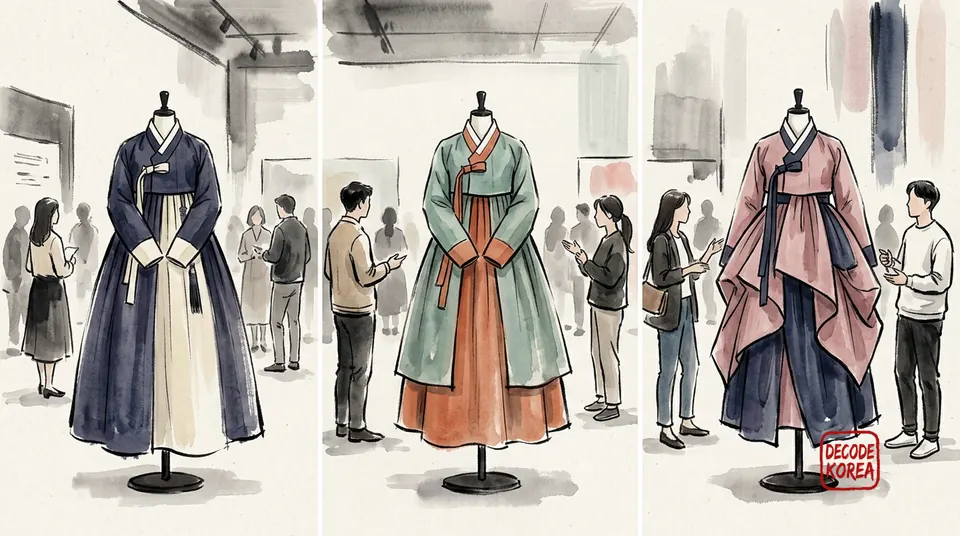
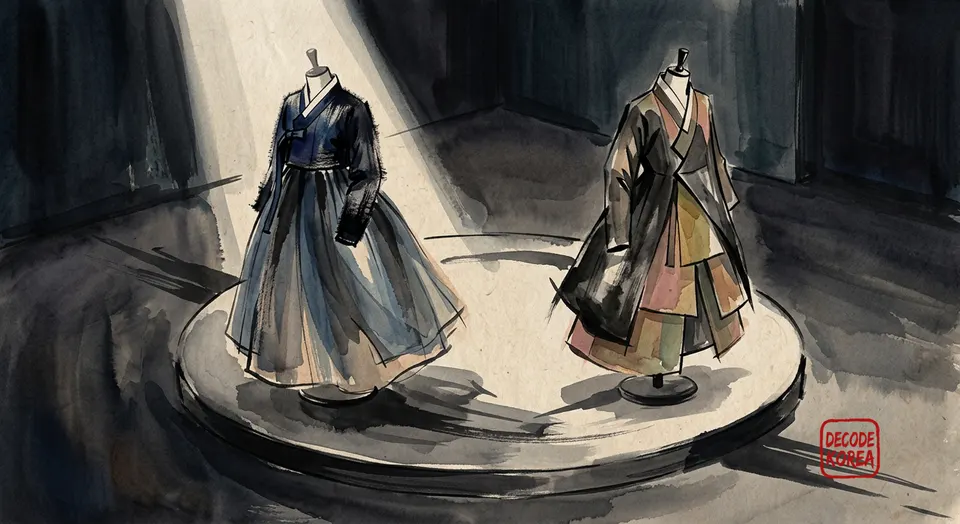
A visual comparison can still train attention without pretending to document the real expo. Look at the generated silhouettes below as a method prompt: outline first, display choice second, interpretation third. The images are original ink-wash illustrations, not evidence of actual garments or exhibitors.
THREE READING LENSES
Separate silhouette from exhibition context
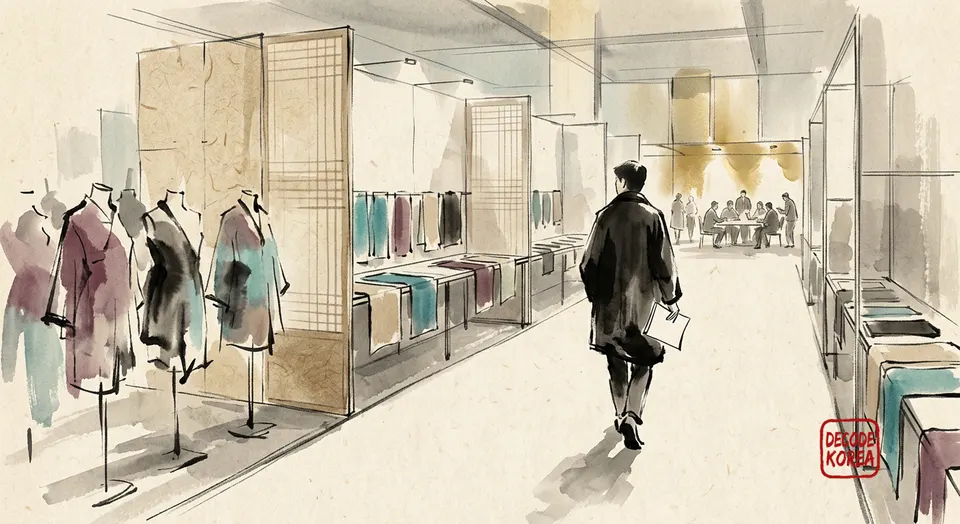
These original illustrations demonstrate a viewing method; they do not reproduce the 2026 expo or any named designer's work.
1 / 2
Source: Korea.net · Interactive trade expo to showcase beauty, trends of Hanbok
Treat trend and tradition as different questions
The Korea.net headline puts beauty and trends together. That pairing is revealing because it signals two kinds of presentation. Beauty is an evaluative frame: the event invites appreciation. Trend is a time-sensitive frame: it draws attention to what is being emphasized now. Neither word supplies a complete cultural history. They tell you how the event is being introduced.
A practical reading method is to ask two questions separately. What features are presented as visually compelling? What features are presented as current? If the same display seems to answer both, resist treating that overlap as proof that current taste defines Hanbok as a whole. Expo selection, lighting, staging, and commercial goals all shape what becomes visible.
This is where translation can flatten context. Modern versus traditional sounds like a clean opposition, but an exhibition may place them in conversation rather than on opposite sides. With only the approved metadata and event framing, the defensible conclusion is modest: the expo presents Hanbok through beauty, trend, interaction, and trade. A stronger claim about how every design relates to history would need garment-level or curator-level evidence not stored here.
Use the English video as orientation, not a second eyewitness
Arirang News published the English-language K-Culture Dive episode on August 13, two days after the dated Korea.net article. Its approved registry record identifies Hanbok among the video's topics. That makes it useful for English-language K-culture orientation and for confirming that Hanbok was part of a current publisher program. The record is description-only, however, so this guide does not attribute detailed statements, quotations, or scenes to the video.
This is an important evidence habit. Two links do not automatically become two independent confirmations of every claim. The Korea.net record carries the direct event framing. The Arirang record carries publisher context and an English viewing path. They complement each other, but they do different jobs.
If you watch the program, apply the same three-lens method: note the garment or visual form, identify how the segment frames it, and separate that editorial frame from any wider claim about Hanbok culture. The method travels across exhibition and broadcast without pretending that the two formats provide identical evidence.
 WATCH ON YOUTUBEK-Culture Dive (2026-08-13)
Open embedded player
Source: YouTube · Arirang News · [FULL] K-Culture Dive (2026-08-13)
Take three lenses into the next Hanbok display
First, look at form. Name the outline, layers, color relationships, and movement you can actually see. Second, look at framing. Notice whether the display emphasizes heritage, experimentation, ceremony, daily wear, craft, performance, or another theme—and verify that label rather than guessing. Third, look at market context. A trade event is also built to connect presentation with professional or commercial activity, even when the stored article metadata does not give you a full exhibitor or transaction record.
These lenses prevent two opposite mistakes. One is to call every current design a break from tradition. The other is to treat every staged garment as a timeless definition. Both collapse a selected display into a total claim. A better response stays specific: this is what the event foregrounds, this is how the garment is framed, and this is where the evidence stops.
The 2026 expo matters here not because it settles what Hanbok is, but because it makes presentation visible. Tradition, trend, and trade can share one room while remaining different analytical questions. Keeping them distinct lets you appreciate the event without asking it to carry more cultural authority than the sources support.
READ, THEN INTERPRET
Form, framing, market
Use the three steps in order whenever a cultural exhibition makes a broad promise.
- 01
Form
Describe the silhouette, layers, color, and movement you can observe.
- 02
Framing
Identify what the event or segment says it is emphasizing.
- 03
Market
Account for the trade setting without inventing sales, attendance, or exhibitor details.
Source: Korea.net · Interactive trade expo to showcase beauty, trends of Hanbok · YouTube · Arirang News · [FULL] K-Culture Dive (2026-08-13)