Start with Chuseok, not just the table
Chuseok is often introduced in English as Korean Thanksgiving. That phrase gives you a quick seasonal handle, but it cannot carry the entire holiday. The stored Koreanet English video is useful for broad orientation: it places Chuseok in a family and holiday frame. The more specific Korean records add another layer, one that is easy to lose when the translation becomes the headline. Chuseok can be discussed as a holiday context without assuming that every household celebrates it through the same table or ceremony.
That distinction changes the question you ask. Instead of looking for the one correct Chuseok meal, look for the relationship between seasonal food, gathering, remembrance, and household choice. A visitor may recognize songpyeon or a formal table arrangement, but recognition is not proof that the same ritual is happening everywhere. The first responsible move is to name the broad holiday, then ask which practice, source, or household the explanation is actually describing.
 WATCH ON YOUTUBEChuseok, Korean Thanksgiving Day
Open embedded player
Source: YouTube · Koreanet · Chuseok, Korean Thanksgiving Day
Treat the formal table as a reference point
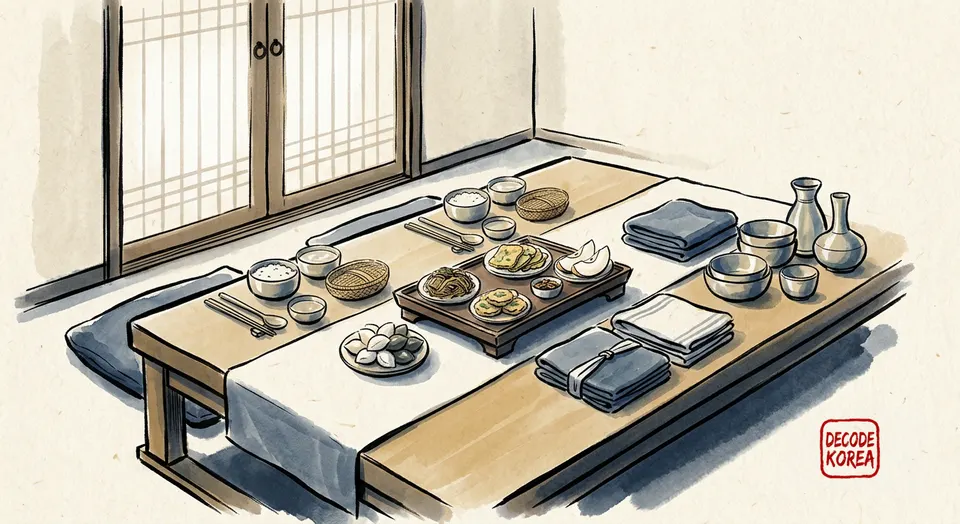
The National Folk Museum's explanation of charye gives you a specific reference point: charye is a memorial service for ancestors held on major traditional holidays, including Chuseok. Korea.net's Chuseok table record gives that memorial layer a visible form, with rows of seasonal foods, fruit, meat, fish, drinks, and ritual objects arranged according to a formal logic rather than the way an everyday meal is usually placed. That is useful evidence, but it is still a reference point.
A reference point is different from a universal rulebook. The formal table helps you understand why the arrangement carries meaning, yet it cannot tell you what every household currently does. It also should not be used to grade a family that chooses fewer dishes, changes the labor involved, or does not perform charye. Read the table as one documented expression of the memorial layer, not as a test that turns variation into error.
SEE THE CHANGE
One holiday, more than one workable arrangement
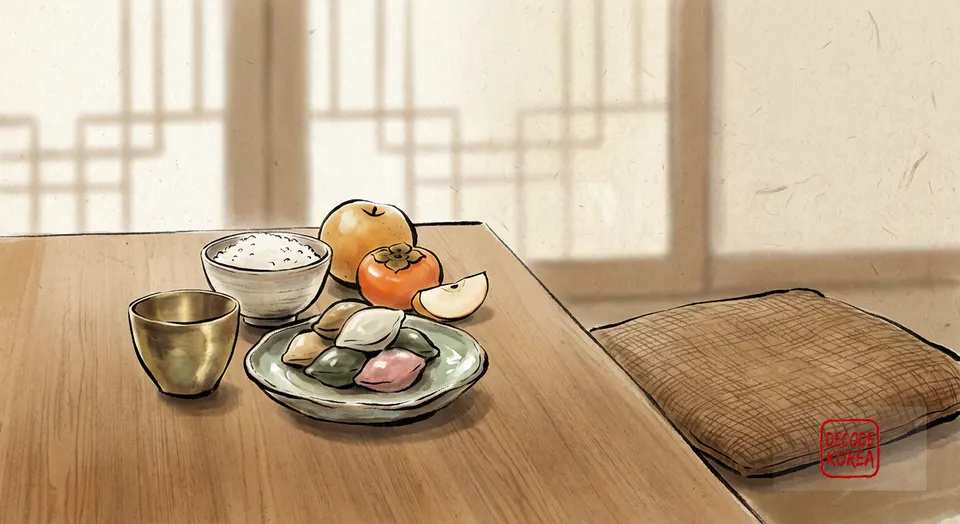
These original ink-wash illustrations make the editorial distinction visible: a formal reference point can coexist with a smaller, adapted serving arrangement.
1 / 2
Source: National Folk Museum of Korea · What is Charye? · Korea.net · 2025 Chuseok Family Festival and Charye Table · Korea.net · Chuseok customs change with passage of time
Read change as adaptation, not automatic disappearance
Korea.net's record on changing Chuseok customs is the key to the article's angle. It lets you describe change as part of the holiday's social life rather than as a simple before-and-after story. Time, available labor, family circumstances, and changing expectations can affect how a household gathers and what work it considers possible. The stored record supports that direction of interpretation, while its official framing also reminds you not to turn one account into a complete census of present-day families.
This is where a small arrangement can be culturally meaningful without being a miniature copy of a formal table. A household may keep seasonal food visible, preserve a moment of remembrance, or gather family members while changing the amount of preparation and the shape of the meal. The evidence does not authorize a claim about every home. It does support a more careful sentence: customs change with social conditions, and adaptation can be part of continuity.
Use three questions before you generalize
When you encounter a Chuseok table in a story, a museum explanation, or a Korean household, separate three questions. First, is the source describing Chuseok as a holiday, charye as a memorial service, or charyesang as a table arrangement? Second, is the example formal, everyday, adapted, regional, or explicitly tied to one family? Third, is the source describing a current practice or explaining a reference tradition? Those questions keep a familiar image from doing more cultural work than the evidence allows.
The wording matters because the same food can appear in more than one frame. Seasonal dishes can be holiday cues, part of a memorial arrangement, or simply food shared by relatives. A table can be a formal example, a teaching image, or a household's own choice. The stored records are strongest when used together: the museum supplies ritual definition, Korea.net supplies formal table and social-change context, and the English video supplies a broad entry point. None should be stretched beyond its role.
A living tradition can look less fixed
The most useful conclusion is not that Chuseok has one table or that every change is evidence of decline. It is that a living holiday can hold a formal reference, a remembered ritual, and practical household decisions at the same time. The shape of the labor may change while the reason for gathering remains legible. Another household may make a different choice, and that difference is part of why the caveat matters.
So when you explain Chuseok, keep the layers in view. Say what the holiday frame contributes. Define charye when the memorial practice is the subject. Use charyesang when the table arrangement is the subject. Then name the limits of the example. That approach gives readers a more accurate picture than a fixed diagram: not a tradition emptied of meaning, and not a single script imposed on every family, but a practice that continues to be interpreted and adjusted over time.