
WAYS TO TRY IT
Two practical ways to use the context
Use the production story to ask better questions, then let the current container control the purchase and cooking decision.
SHOP THE AISLE
Read the current jar
What should you verify before buying doenjang?
- START HERE
- Confirm that the label says doenjang or 된장, then read the ingredients, net weight, storage directions, and live shelf price.
- CHECK THIS
- Do not assume that every product follows one historical process or that darker paste proves a particular age or flavor.
Source: 한국민족문화대백과사전 · 된장 (Doenjang) · 농촌진흥청 · 고품질 된장 메주 침지 기간
COOK AT HOME
Season before you imitate
How should the historical context affect home cooking?
- START HERE
- Treat doenjang as a seasoning and follow package storage guidance and a tested recipe for the dish you are making.
- CHECK THIS
- The RDA report concerns production quality; it does not supply quantities or safety instructions for making doenjang at home.
Source: 한국민족문화대백과사전 · 된장 (Doenjang) · 농촌진흥청 · 고품질 된장 메주 침지 기간
The translation names the ingredient, not the whole process
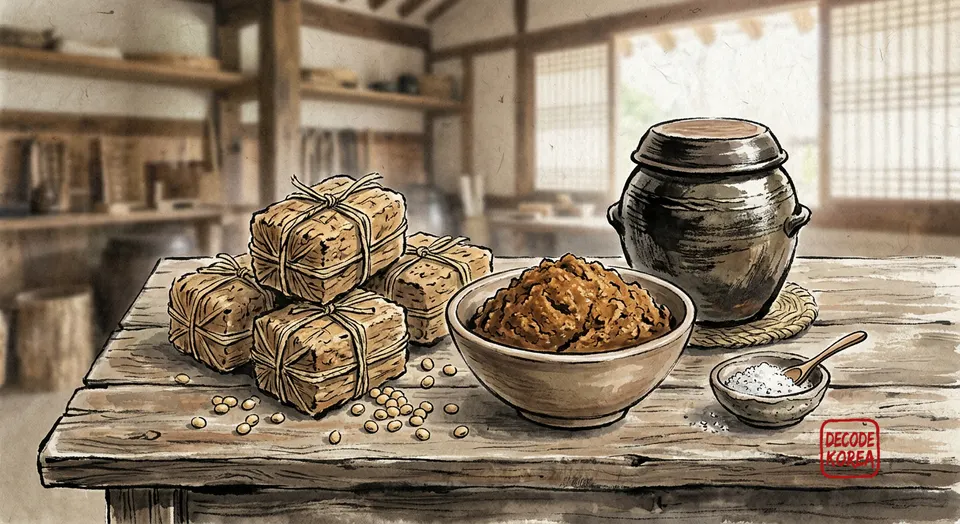
Calling doenjang ‘fermented soybean paste’ is useful, but it compresses several steps into three English words. The Academy of Korean Studies defines it through meju: blocks made from cooked soybeans that are used to prepare jang. In one familiar route, the blocks mature in salt water, the liquid is drawn off as soy sauce, and the remaining solids are worked into doenjang.
That sequence explains why doenjang and Korean soy sauce can belong to the same production story. It also prevents a common mistake: doenjang is not simply raw soybeans blended into a brown condiment. Fermentation and the treatment of meju are central to its identity.
The same entry records forms made without drawing off the soy-sauce liquid. One compact definition should not be mistaken for a universal formula. Doenjang names a Korean jang tradition with documented variation, not one fixed industrial specification.
SEE THE INGREDIENT LINEAGE
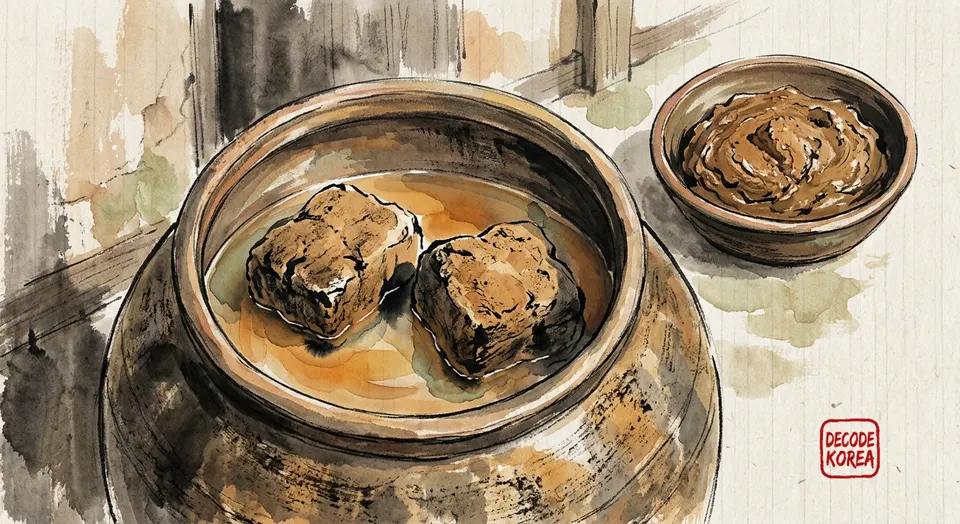
Meju, brine, and paste are related—but not interchangeable
The paintings make the vocabulary visible without documenting a particular producer or batch.
1 / 2
Source: 한국민족문화대백과사전 · 된장 (Doenjang) · 농촌진흥청 · 고품질 된장 메주 침지 기간
A long history, with careful verbs
The encyclopedia places soybean cultivation in Korea around the early Iron Age and points to old records of fermented jang. Some early production history is reconstructed from later texts and comparison, so the responsible language is ‘recorded,’ ‘described,’ or ‘inferred’—not a claim that one modern jar reproduces an ancient recipe.
More concrete written methods appear in Joseon-era sources discussed by the entry. Those descriptions include boiling soybeans, forming and fermenting meju, drying it, and later aging it with salt water. Details differ across texts, and the entry notes regional standalone jang forms.
For a present-day reader, the history is useful as a map of relationships. Soybeans become meju; meju enters a jang-making process; liquid and solids may be separated or kept together. That map gives more context than a claim of timeless authenticity.
What the 50-day finding does—and does not—mean
A March 6, 2020 Rural Development Administration page reports guidance from the Chungcheongnam-do Agricultural Research and Extension Services on the period that meju remains in brine during traditional doenjang production. The report says longer soaking can move measured nitrogen indicators in an unfavorable direction and can contribute to an off odor when the period extends beyond 70 days.
The agency's researcher recommended an appropriate soaking period within 50 days and advised not exceeding 70 days, while also limiting temperature variation during the long fermentation. This is a specific production finding attached to a named institution and date. It adds a measurable variable to the historical account.
It is not a home recipe. The page does not provide a complete formula for salinity, sanitation, vessel management, climate, or every production system. Use it to understand that time in brine can affect quality—not to start an unsupervised fermentation from a single number.
Look closer
undefined
undefined
- 01
1. Meju
Cooked soybeans are formed and fermented into blocks used for jang.
- 02
2. Brine
Meju ages in salt water; the RDA report studies duration as a quality variable.
- 03
3. Separate—or not
One route draws off liquid; documented standalone forms keep components together.
- 04
4. Verify
A current jar needs its own ingredient, storage, and price check.
Source: 한국민족문화대백과사전 · 된장 (Doenjang) · 농촌진흥청 · 고품질 된장 메주 침지 기간
Turn the history into a better label check
At a grocery store, begin with the product in front of you. Confirm the Korean or English product name, read the ingredient list, note the net weight, and follow the manufacturer's storage directions. If salt or allergens matter to you, use the current nutrition and ingredient panels rather than a historical description.
The two approved sources do not provide a current retail price, package comparison, or tasting panel. This guide therefore makes no bargain claim and no flavor ranking. Record the live shelf price and divide it by package weight if you want to compare value across sizes.
Color, looseness, and visible soybean pieces may help you describe what you see, but they do not independently prove age, region, or quality. A useful first jar is one whose name, ingredients, storage instructions, and intended use you understand—not one selected from an imagined authenticity scale.
Look closer
undefined
undefined
- 01
Name
Confirm doenjang or 된장 on the package.
- 02
Label
Read ingredients, net weight, storage directions, and live price.
- 03
Boundary
Do not infer age, region, flavor, or health effects from color or history alone.
Source: 한국민족문화대백과사전 · 된장 (Doenjang) · 농촌진흥청 · 고품질 된장 메주 침지 기간
Use the first spoonful as seasoning
The encyclopedia describes doenjang as a basic seasoning used to set the salt and flavor of food, including seasoned vegetables and soups. That is a safer starting idea than assuming it should be eaten by the spoonful or substituted one-for-one for every other soybean paste.
For your first use, choose a tested dish recipe and add the paste in stages, because concentration and salt level can vary by product. Taste the prepared dish rather than the uncooked paste alone. Keep health, probiotic, or nutritional conclusions outside the purchase decision unless the current label and appropriate medical guidance support them.
The next step is simple: identify the jar, read what is current, and use fermentation history as context. Meju and brine explain how the category became legible; the package in your hand decides how that particular doenjang should be stored and used.