
WAYS TO TRY IT
Three easy ways to meet namul
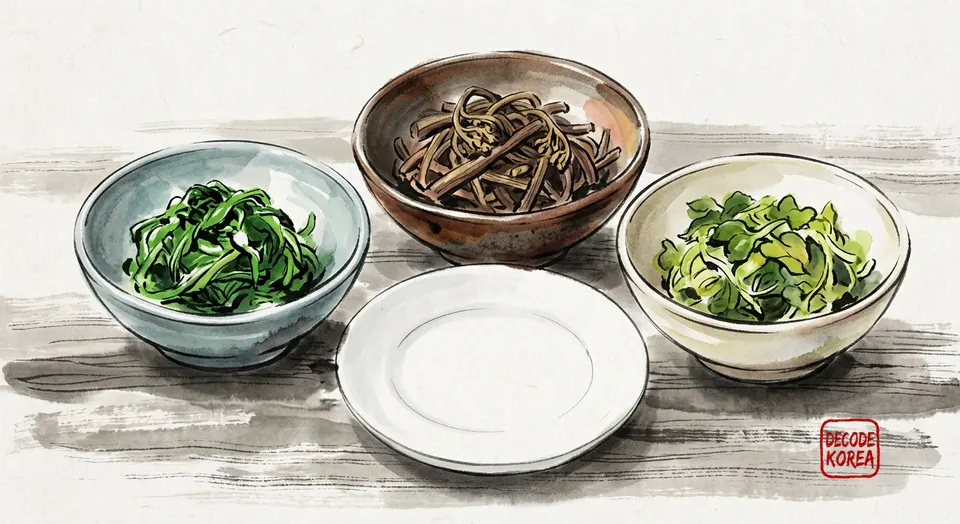
Choose the route that matches how you want to learn the category: taste a small side, read a prepared-food label, or season a familiar green at home.
VISIT IN KOREA
Start with two banchan
What should I order when the plant names are unfamiliar?
- START HERE
- Choose one tender leafy namul and one sturdier stem or dried-vegetable namul.
- CHECK THIS
- Compare the bite and seasoning with a little rice.
Source: 한국민족문화대백과사전 · 나물 (Namul) · Korea.net · Energy-boosting seasonal vegetables signal spring's arrival
SHOP THE AISLE
Read the prepared-food case
How do I treat a chilled namul as food rather than a raw salad?
- START HERE
- Look for the plant name and whether the dish is seasoned, blanched, or marinated.
- CHECK THIS
- Use the texture description and keep the serving small beside rice or soup.
Source: 한국민족문화대백과사전 · 나물 (Namul) · VISITKOREA · 33 Regional Foods
COOK AT HOME
Use one familiar green
What is the simplest first home experiment?
- START HERE
- Blanch spinach or another sturdy leafy green, cool it, and squeeze it well.
- CHECK THIS
- Add seasoning gradually so the vegetable stays the loudest flavor.
Source: 한국민족문화대백과사전 · 나물 (Namul) · Korea.net · Representative Temple Dishes and Cooking Methods
Namul names a family, not a fixed recipe
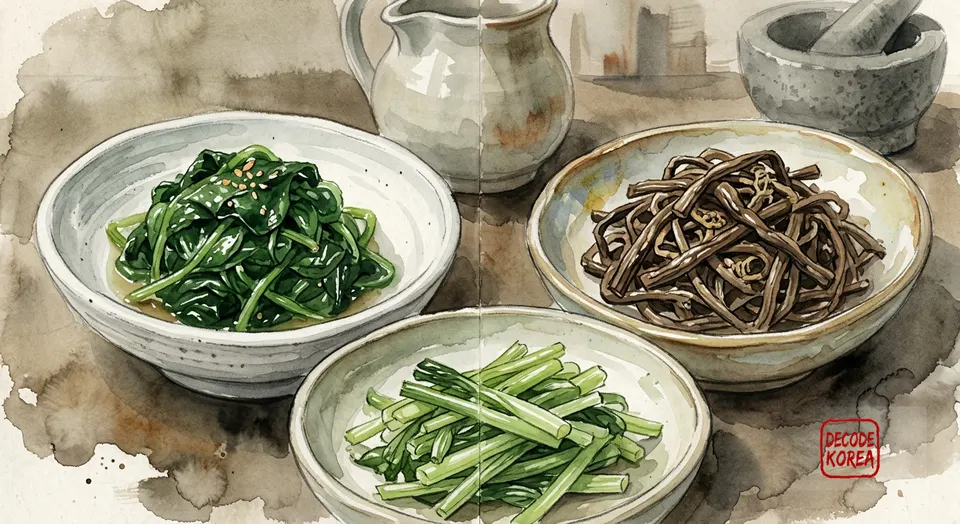
When a menu says namul, do not picture one canonical plate. The word works more like a family label for edible plants that have been prepared and seasoned as a small side dish. A bowl of spinach, a tangle of fernbrake, and a pile of bean sprouts can all belong to the category while tasting and feeling completely different.
That is why a translation such as ‘seasoned vegetables’ is technically useful but practically incomplete. It tells you the role of the dish, not its plant, texture, or cooking path. The first question to ask is not ‘What is namul made of?’ but ‘Which plant, and how was it handled?’ The Encyclopedia of Korean Culture describes namul as a food culture built around edible plants and their varied preparation, which is the stable idea behind the many bowls on a table.
The plant and the season do most of the naming work
Korean cooks use leaves, stems, shoots, roots, mushrooms, and wild greens for namul. The ingredient may be familiar, like spinach or bean sprouts, or it may be a mountain vegetable whose Korean name is left untranslated on a menu. When spring greens appear, their freshness and slight bitterness are part of the point; when dried gosari or other stored vegetables return to the table, the softened chew is part of the story.
Official Korean food writing often links seasonal vegetables with the arrival of spring, not because every namul is a spring dish, but because seasonality helps explain why the category feels so varied. A restaurant may change its vegetable sides with the market, while a home cook may reach for dried greens that were prepared earlier in the year. The name tells you there is a plant at the center; the season tells you what kind of bite to expect.
Three preparation signals make the category easier to read
Start with the water. Tender greens are often blanched or steamed until they relax but keep some life, then squeezed and seasoned. That short cooking step fixes the texture and removes the raw edge without turning the vegetable into a purée. Spinach namul is a clear example: the leaves become compact, glossy, and easy to pick up with chopsticks, while sesame, garlic, salt, or soy add the direction of flavor.
Next, look for the dry-to-soft transformation. Dried mountain greens such as gosari are soaked, boiled, and often briefly stir-fried or simmered with seasoning. They do not try to imitate a tender salad. Their appeal is a deeper, more elastic chew and the way they carry a savory sauce. Finally, some vegetables are cooked directly in a pan, especially when a little moisture and time are needed to soften a stem or root. These are different routes to the same table role: a concentrated vegetable side that can be eaten in small bites with rice.
READ THE PREPARATION
From plant to banchan in three moves
The category becomes clearer when you follow what happens to the vegetable before the seasoning reaches it.
- 01
Soften 데치기 · blanch
Blanch or steam tender leaves just until they relax, then cool and squeeze them so the dressing can cling.
- 02
Restore 불리기 · soak
Rehydrate dried greens and roots until their stored, chewy texture becomes ready for cooking.
- 03
Season 무치기 · dress
Add salt, soy, sesame oil, garlic, or other seasonings with enough restraint for the plant to remain visible.
Seasoning changes the mood without erasing the plant
Namul seasoning is usually built to keep the vegetable legible. Sesame oil can give a warm, nutty finish; toasted sesame seeds add a small crunch; garlic, scallion, soy sauce, salt, or a little perilla oil can deepen the dish. The balance is not identical from cook to cook, and a restaurant’s version may be more or less salty, sweet, oily, or spicy.
This is a useful contrast with heavily sauced dishes. If the first bite tastes like one uniform sauce, pause and look for the plant’s original signal: a leaf that folds, a stem that snaps, or a dried green that resists slightly before yielding. Temple-cuisine guidance from Korea.net is especially helpful here because it shows how vegetable dishes can be built around restraint, seasonal ingredients, and technique rather than a single dominant flavor.
On a banchan table, namul supplies contrast
Namul makes the most sense as part of a meal, not as a solo category quiz. Next to rice, soup, grilled meat, jeon, or a stew, a vegetable side can bring coolness, chew, bitterness, softness, or a clean sesame aroma. Two dishes may both be called namul and still be chosen for opposite reasons: one to add a tender green note, another to slow down a rich bite.
The small serving size is part of the design. You can take a little with rice, switch to another banchan, and notice how the seasoning changes the next bite. That rhythm is why namul also works in a bibimbap bowl. The vegetables are prepared separately so their colors and textures remain visible before the final mix. Once stirred with rice and gochujang, the bowl becomes one meal, but the separate preparations still give it shape.
Source: 한국민족문화대백과사전 · 나물 (Namul) · Korea.net · Energy-boosting seasonal vegetables signal spring's arrival
Everyday banchan and temple tables share a vegetable focus
Namul appears in ordinary meals and in more specifically documented culinary traditions. That does not mean every namul is temple food, or that one seasoning rule applies everywhere. It means vegetables are important enough to carry a meal’s identity, and different tables make different choices about ingredients, aromatics, and cooking fat.
Korea.net’s overview of representative temple dishes places seasonal plants and careful preparation at the center of that tradition. Read alongside the broader cultural definition of namul, it gives you a practical distinction: the category is wide, while a particular table’s ingredient rules and seasoning choices are narrower. Keep those levels separate and you can appreciate temple namul without turning it into a label for every vegetable side.
The best first bite is a texture comparison
For a first introduction, choose two namul with visibly different structures: a tender leaf such as spinach and a more substantial dried or stem vegetable such as gosari. Taste each with a little rice before adding anything else. Notice whether the seasoning arrives first or whether the plant keeps its shape long enough to make a second impression.
That comparison is the simplest answer to the question ‘What is namul?’ It is a vegetable dish shaped by handling. The category holds blanching, soaking, steaming, pan-cooking, drying, and seasoning together, but the point is not to flatten those methods into one definition. Pick the plant, read the texture, and let the small side dish show you how Korean meals make vegetables do more than fill a gap on the plate.