Mul-Naengmyeon or Bibim-Naengmyeon? Build Your First Cold-Noodle Bowl
The broth bowl and the sauce-coated bowl ask for different choices. Here is how to read the kit, cook the noodles, and keep the texture cold and springy.
Quick take: Start with mul-naengmyeon if you want a cold, clean, broth-led bowl; choose bibim-naengmyeon if you want sauce, heat, and a stronger first bite. In either case, separate the noodles, boil them briefly, rinse them in very cold water, and drain them well before adding broth or sauce.
· Updated 2026-08-11 · Decode Korea · 5 sources checked
WAYS TO TRY IT
Four ways to get to the bowl
You can learn the difference in a Seoul restaurant, find a chilled kit in a Korean grocery aisle, or build the comparison in your own kitchen.
VISIT IN KOREA
Order the contrast in Korea
What should you notice when a restaurant serves both styles?
START HERE
Ask whether the menu is mul-naengmyeon, bibim-naengmyeon, or a regional preparation before choosing toppings.
CHECK THIS
Taste the broth or sauce first, then notice the noodle chew and how the toppings change the bowl.
The kit is convenient, but the result still depends on sequence. Keep the noodles cold, the liquid separate until the end, and your first adjustment small.
01
Choose the bowl before you boil
Decide whether you want mul-naengmyeon or bibim-naengmyeon.
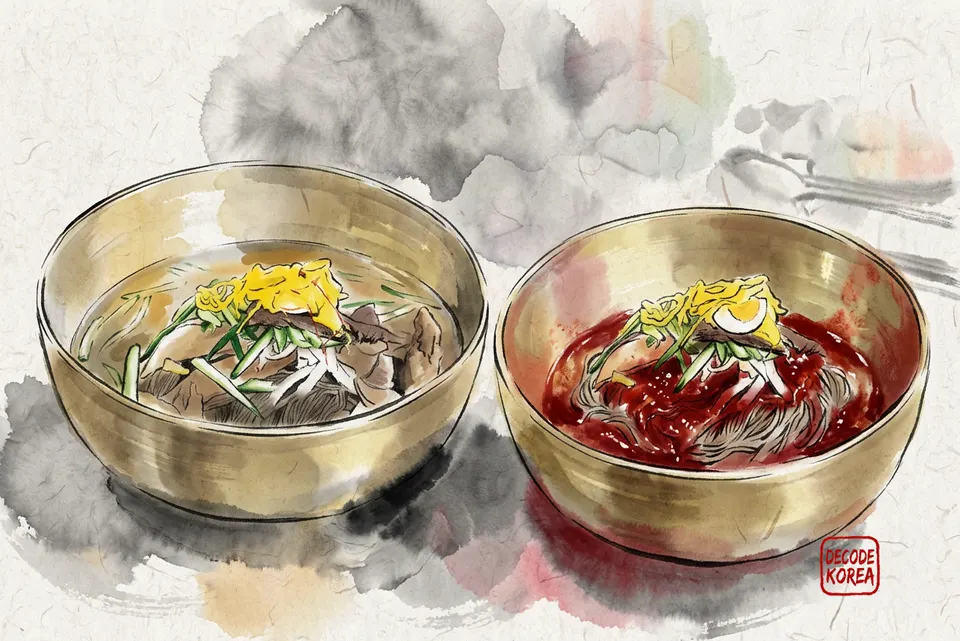
Mul-naengmyeon is the broth-led bowl. The Korean menu translation guide distinguishes 냉면 or 물냉면 from 비빔냉면, where the noodles are mixed with seasoning. A package that says 동치미 물냉면 points you toward a radish-brine-style broth; a package that says 비빔냉면 points you toward sauce. Start there instead of treating every cold noodle kit as interchangeable.
Useful phrase: 물냉면이에요? 비빔냉면이에요?(Is it mul-naengmyeon or bibim-naengmyeon?)
The bowl changes quickly after boiling. Compare the broth, sauce, noodle sheen, and toppings before you decide what you want.
1 / 2
02
Separate every component
Open the kit and keep noodles, broth, sauce, toppings, and mustard in their own places.
Food Safety Korea describes a meal kit as measured ingredients and seasonings packaged with a cooking method. That means the instruction sheet is part of the product, not decoration. Check the storage label and identify what needs chilling before you boil water. If a package includes both broth and sauce, do not pour either one into the bowl yet.
Useful phrase: 육수는 따로 둘게요.(I’ll keep the broth separate.)
Separate the chilled noodle bundle with your fingers before it hits the boiling water.
A tight bundle cooks unevenly. The outside softens while the middle stays clumped, which makes the later rinse less useful. Follow the package's suggested cooking time as the starting point. The CJ product page, for example, directs cooks to loosen the noodles in cold water just before boiling and uses a short boil rather than a long simmer.
Useful phrase: 면을 먼저 풀어 주세요.(Please loosen the noodles first.)
Use a full boil and watch the clock instead of waiting for the noodles to look soft in the pot.
Naengmyeon noodles are meant to stay springy. The exact timing depends on the product, so the package wins over a universal number. Start with its instruction, then adjust only after you have tasted the result once. Overcooking gives you a soft bowl that no amount of cold broth can fully repair.
Useful phrase: 조리 시간을 확인해 주세요.(Please check the cooking time.)
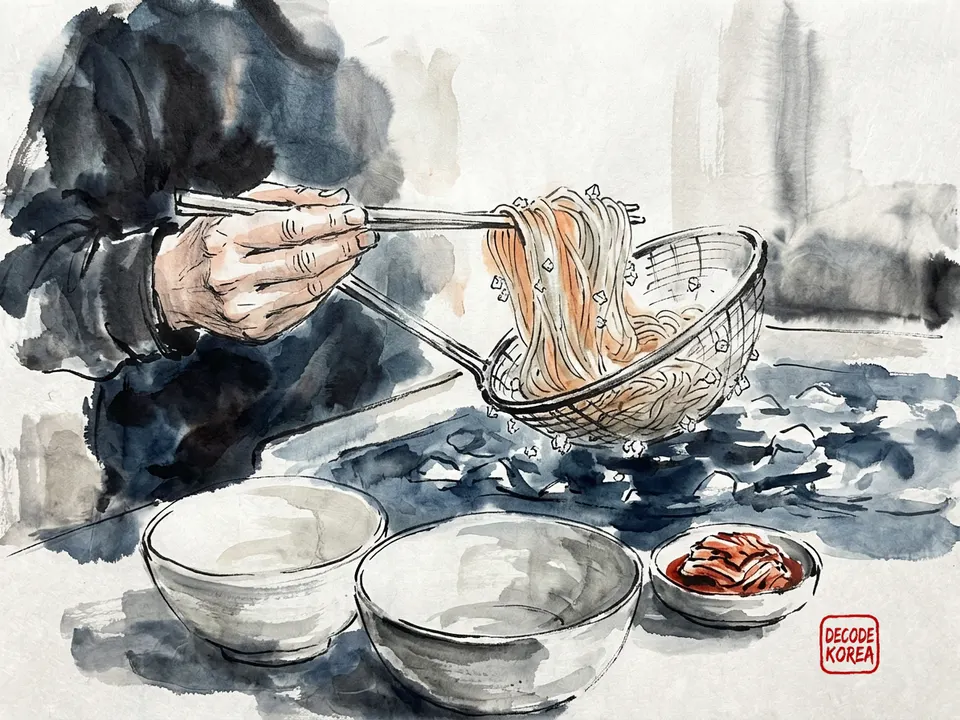
Drain the noodles and rinse them in very cold water, separating the strands as you go.
This is the step that turns a hot pot of noodles into a cold noodle bowl. Rinsing removes surface starch and stops the cooking. The goal is not a dramatic ice bath for its own sake; it is a cold, clean, springy strand with no warm center. Drain thoroughly. Excess water dilutes the broth and makes the sauce slide off.
Useful phrase: 찬물에 헹궈 주세요.(Please rinse it in cold water.)
Add broth or sauce only after the noodles are cold and drained, then taste before adding mustard, vinegar, or extra toppings.
For mul-naengmyeon, pour the chilled broth over the noodles and add mustard gradually. For bibim-naengmyeon, coat the noodles with the sauce and taste before adding more. Dongchimi is a useful cultural clue: Korea.net describes the radish brine as something that can be used to make cold noodles. It is a broth tradition, not a command to make every bowl taste the same. Your kit may be sharper, sweeter, or saltier.
Useful phrase: 조금씩 넣어 볼게요.(I’ll add it a little at a time.)
Korea.net's dongchimi cooking guide explains that dongchimi liquid can be used to make naengmyeon, connecting the chilled noodle bowl to a Korean radish-brine tradition.
CJ THE MARKET's dongchimi mul-naengmyeon product page lists a two-serving kit and instructs cooks to loosen the noodles before boiling briefly and rinsing in cold water.
The article's rinse-and-drain rule is an original synthesis of the product method and the bowl's desired cold, springy texture; it is a cooking framework, not a universal product instruction.
The article's second-bowl test changes one variable at a time so a cook can compare broth, sauce, drainage, or toppings without treating one kit as representative of all naengmyeon.