
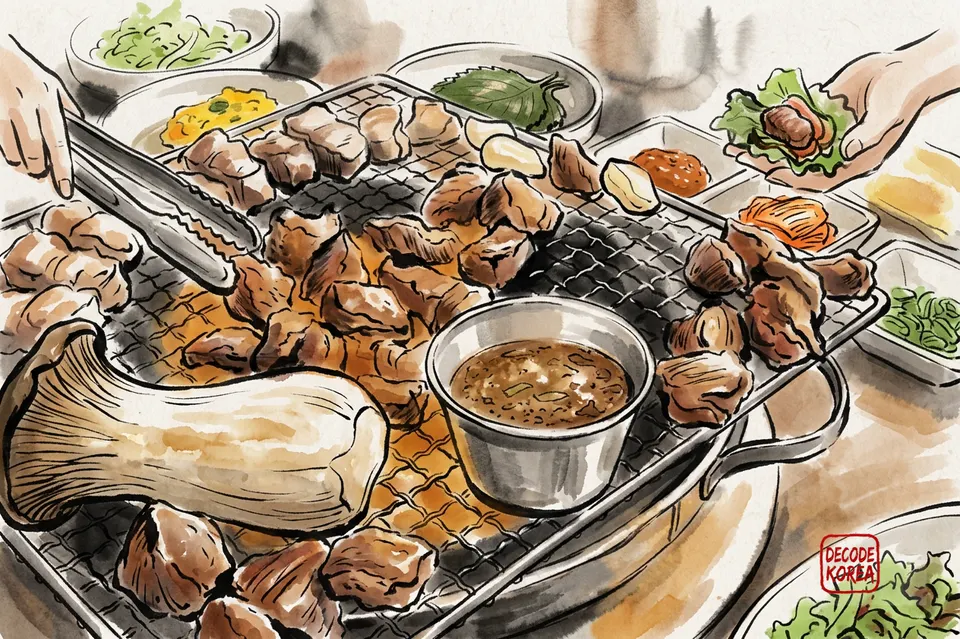
WAYS TO TRY IT
Choose your way in
Start with the route that fits the way you want to experience the dish.
VISIT IN KOREA
Try the original context
What should you notice when you encounter this food in Korea?
- START HERE
- Use the article's menu or serving clues as your starting point.
- CHECK THIS
- Notice the dish name, serving format, and the detail that changes the experience.
Source: VISITKOREA · A Bite of Korea: Salad, Leaf Wraps & Korean BBQ · VISITKOREA · Grilled Pork Belly (Samgyeopsal)
COOK AT HOME
Take the idea home
What part of the food can you try without reproducing a restaurant?
- START HERE
- Start with the ingredient or technique described in the article.
- CHECK THIS
- Treat substitutions as an adaptation and keep the source-backed structure intact.
Source: VISITKOREA · A Bite of Korea: Salad, Leaf Wraps & Korean BBQ · VISITKOREA · Grilled Pork Belly (Samgyeopsal)
FIRST-TIMER GUIDE
The five decisions that make the table easy
You do not need to memorize every cut or every banchan. Make these decisions in order, then let the table show you what comes next.
- 01
Pick one plain grill and one marinated option
Start with samgyeopsal if you want to taste the meat without a heavy marinade; add bulgogi or another seasoned cut if you want a sweeter, more immediately familiar flavor.
Samgyeopsal is grilled pork belly and one of the most recognizable entry points to Korean barbecue. The point of ordering one straightforward cut is not to find a universal ‘best’ meat. It gives you a baseline for the dipping sauces, wraps, garlic, and pickles that arrive around it. If you are eating with a group, two contrasting orders create more useful variety than several similar marinated plates.
Useful phrase: Samgyeopsal hana, bulgogi hana juseyo. (One samgyeopsal and one bulgogi, please.)
Source: VISITKOREA · A Bite of Korea: Salad, Leaf Wraps & Korean BBQ · VISITKOREA · Grilled Pork Belly (Samgyeopsal) · National Institute of Korean Language
- 02
Let the table setup tell you who is grilling
Look at the center grill, the ventilation hood, and the staff’s movements before putting meat down.
Some Korean barbecue restaurants expect diners to cook at the table; at others, staff handle the grill or tell you when the meat is ready. VISITKOREA notes both patterns. If you are unsure, ask before the first piece goes on. A short question is easier than rescuing meat that has cooked too long, and asking for help is normal in a restaurant built around a live grill.
Useful phrase: Nuga guwo juseyo? (Who grills it?)
Source: VISITKOREA · A Bite of Korea: Salad, Leaf Wraps & Korean BBQ · National Institute of Korean Language
- 03
Treat banchan as part of the bite
Taste the small plates before the meat arrives, then use them as accents rather than trying to finish them separately.
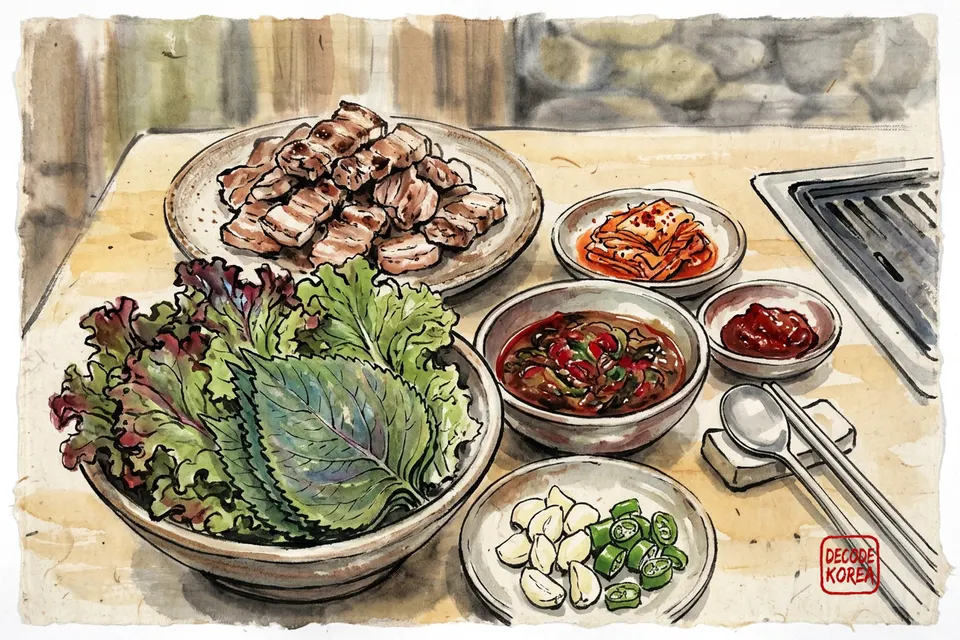
The side dishes are not a decorative starter course. Korean BBQ tables may include scallion salad, pickled onion, sliced radish, garlic, peppers, kimchi, and other banchan that cut through the richness of grilled meat. You can eat them on their own, place a little inside a wrap, or use them to compare how the same piece of meat changes with salt, sesame oil, or ssamjang.
Useful phrase: Igeo mwo-yeyo? (What is this?)
Source: VISITKOREA · A Bite of Korea: Salad, Leaf Wraps & Korean BBQ · Hansik Magazine · K-BBQ and Its Companions · National Institute of Korean Language
- 04
Build one ssam before you build a theory
Take a lettuce or perilla leaf, add meat, a small amount of ssamjang, and one or two sides, then fold it into a single bite.
Ssam is the table’s simplest lesson in balance. The leaf supplies freshness, the meat brings fat and heat, the paste adds fermented depth, and the small side dishes change the texture. Start small: too much filling makes the wrap fall apart and hides the differences between the ingredients. Once you know what you like, add garlic, scallion salad, or a pickled vegetable.
Useful phrase: Ssamjang jom deo juseyo. (Please give me a little more ssamjang.)
Source: VISITKOREA · A Bite of Korea: Salad, Leaf Wraps & Korean BBQ · Hansik Magazine · K-BBQ and Its Companions · National Institute of Korean Language
- 05
Choose a finish while you still have room
Decide between a stew, noodles, or fried rice before the grill is completely cleared.
A Korean BBQ meal often has a second act. VISITKOREA highlights doenjangjjigae and fried rice as familiar ways to finish, while Korean food coverage also places noodles and soup alongside the grilled meat. The finish changes the memory of the meal: stew adds warmth and broth, noodles make the table feel lighter, and fried rice turns the last traces of meat and sauce into something new.
Useful phrase: Bap bokkeum haejuseyo. (Please make fried rice.)
Source: VISITKOREA · A Bite of Korea: Salad, Leaf Wraps & Korean BBQ · Hansik Magazine · K-BBQ and Its Companions · National Institute of Korean Language
What you are actually ordering
Korean BBQ is not one dish with one standard plate. It is a restaurant format in which meat is grilled at the center of the table and eaten with sauces, leaves, pickles, vegetables, rice, soup, or noodles. The grill creates the obvious spectacle, but the meal’s structure comes from the things that surround it. That is why a first order can feel confusing if you treat the menu like a list of steaks and ignore everything else that arrives.
A useful comparison is a cook-at-the-table restaurant, but the Korean version has its own rhythm. You choose the main meat, watch or share the cooking, make small combinations from the table, and decide whether the last few bites become soup, noodles, or fried rice. There is no need to sample every side dish. You only need to notice that the table has been designed for combination.
A simple way in
Read the dish in three moves
Use the article's distinctions in sequence instead of trying to memorize every term at once.
- 01
Notice
Start with the visible ingredient, serving style, or menu word.
- 02
Compare
Use the article's key distinction to separate the closest-looking options.
- 03
Choose
Make one first order or cooking decision, then adjust from experience.
Source: VISITKOREA · A Bite of Korea: Salad, Leaf Wraps & Korean BBQ · VISITKOREA · Grilled Pork Belly (Samgyeopsal) · Hansik Magazine · K-BBQ and Its Companions
Why samgyeopsal is a useful first order
Samgyeopsal is grilled pork belly, cut into pieces for the table grill. VISITKOREA describes it as a favorite pork cut eaten with red chili and soybean paste or sesame oil with salt, and wrapped in lettuce or enjoyed with garlic. Those details make it a practical baseline: the meat is recognizable, while the surrounding sauces and leaves show you how Korean BBQ changes from bite to bite.
If you prefer beef, bulgogi gives you a different route into the same table culture. The important distinction is not that one is more authentic than the other. It is that plain grilled meat lets you control the seasoning at the table, while marinated meat arrives with more of its flavor already decided. Ordering both, when the group is large enough, turns that difference into a direct comparison.
The side dishes are the meal’s mixing board
Hansik’s coverage of K-BBQ emphasizes the companion foods that keep grilled meat from becoming a monotonous plate: green onion, pickled onion, jangajji, sliced radish, garlic, peppers, ssamjang, sesame oil, and salted seafood. You do not have to identify every Korean name on the first visit. Watch for three functions instead: something fresh, something sharp or pickled, and something salty or fermented.
Ssam brings those functions into one bite. Put the leaf in your palm, add less than you think you need, and fold from the bottom. A small wrap lets you taste the meat, sauce, and side dish separately before they disappear together. If lettuce feels familiar, try perilla next; its aroma makes the same meat feel like a different order.
SEE THE DISH
The table is part of the meal
Before the grill gets hot, notice the pieces that make Korean BBQ feel like a shared table rather than a single plated dish.
1 / 2
What to do when you are not sure
Ask early. If you do not know whether staff grill the meat, whether a sauce contains seafood, or whether a side dish is spicy, ask before you begin. ‘Yeogiyo’ is the useful call for getting a server’s attention, and VISITKOREA includes it in its first-timer guidance. You are not interrupting the experience by asking; the restaurant format assumes that diners may need help with the grill and the table.
Ingredient questions are worth making explicit. A vegetable-centered meal may still include egg, fish sauce, shrimp, sesame, or meat-based broth, and menus vary by restaurant. If you have an allergy or dietary restriction, state it clearly and ask what can be changed. Treat the restaurant’s answer as the source of truth for that table rather than relying on an English menu translation alone.
The simplest first-meal plan
For two diners, start with one order of samgyeopsal, one contrasting meat if the menu offers it, and whatever rice or soup the restaurant recommends. Taste the banchan first. Ask who is grilling. Make one ssam with only meat and ssamjang, then a second with a pickled or fresh side. This gives you a sequence rather than a pile of unfamiliar plates.
For a first meal in Seoul, choose a restaurant where the menu explains the cuts or where staff can help with questions. After that, seek out a smaller neighborhood gogi-jip and repeat the same order. The point is not to turn Korean BBQ into a checklist. It is to recognize the pattern well enough that the next table feels inviting instead of intimidating.
Open embedded player
Source: YouTube · King Kogi · How to Set Up Korean BBQ at Home