Start with three layers
The Korea Season headline gives you a route: a Korean ministry-backed K-culture festival frame moving through Thailand and Vietnam. It does not, by itself, make the two stops equivalent. A title can remain constant while program choices, partners, venues, language, and audience expectations change.
Use three layers. First, identify the exported frame: who named and organized the program. Second, inspect the forms actually programmed. Third, ask how the host context shapes access and interpretation. This order keeps an announcement useful without turning it into evidence the source does not contain.
The first original insight is that continuity and difference can coexist. The shared banner creates continuity; local programming and reception create difference. Neither cancels the other.
Do not flatten K-culture into one genre
Arirang's August 21 K-Culture Dive description is a useful media cue because it places several subjects under one program title: NCT DREAM, an AI news segment, novelist and independence activist Shim Hoon's manuscript, bingsu, and forthcoming Korean films. The record is description-only, so this guide does not quote or make scene-level claims about the broadcast.
That breadth shows what the K-culture label can do: help an international audience navigate across music, heritage, food, and film. It also shows the label's limit. Those subjects do not become the same kind of culture merely because one broadcast groups them.
The second insight follows: treat K-culture as a table of contents. Move from the label to the named form, then ask what evidence and context that form needs.
 WATCH ON YOUTUBE[LIVE] K-Culture Dive (2026-08-21)
Open embedded player
Source: YouTube · Arirang News · [LIVE] K-Culture Dive (2026-08-21)
Compare host contexts without inventing reception
Thailand and Vietnam should remain separate analytical questions. The approved news record names both host countries, but the stored evidence does not support claims about identical schedules, local partners, audience size, critical response, or how visitors interpreted a performance.
Before acting on the announcement, open the current organizer information for the relevant country and date. Check the actual lineup, venue, admission, language access, and schedule. Then look for local reporting or participant accounts if your question is about reception rather than programming.
This is not a demand to rank the two hosts. It is a safeguard against treating place as scenery. Cultural exchange becomes legible when the host side is evidence, not an assumption.
FRAME AND CONTEXT
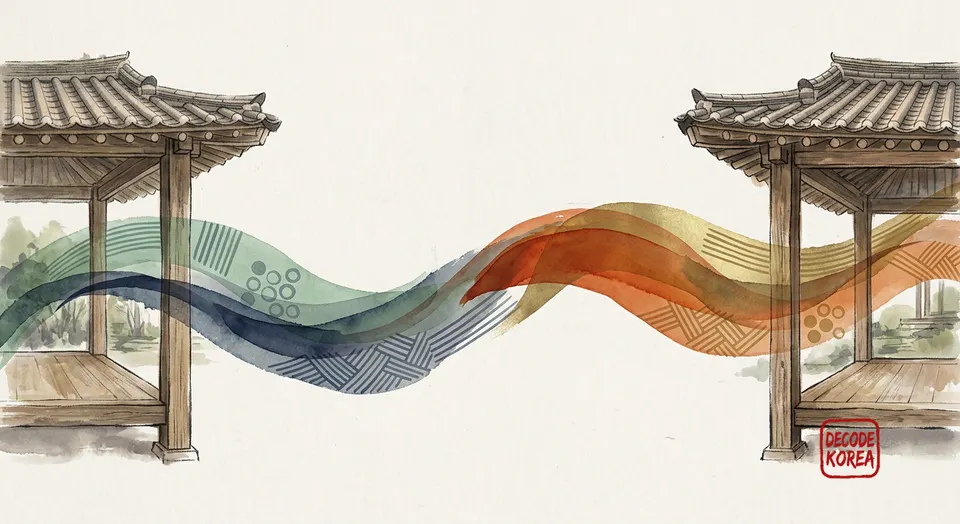
One current, two encounters
These original illustrations explain the framework; they do not depict a real Korea Season venue, program, or audience.

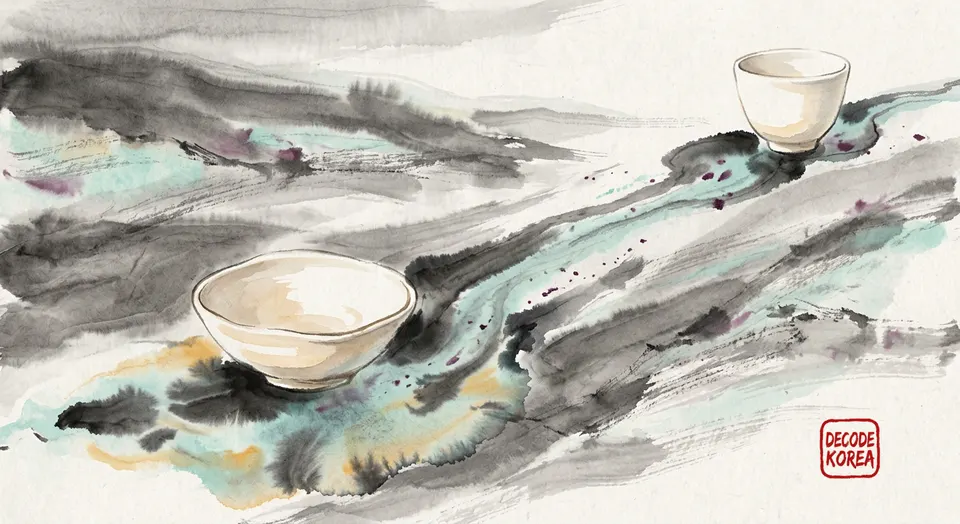
1 / 2
Source: The Asia Business Daily · Ministry of Culture to Host K-Culture Festival ‘2026 Korea Season’ in Thailand and Vietnam · YouTube · Arirang News · [LIVE] K-Culture Dive (2026-08-21)
Use one decision rule
Ask three questions in order: Who framed the exchange? What specific cultural form is present? What does the host context change? If a source answers only the first question, do not borrow answers to the other two.
For Korea Season, the news report supports the ministry-announced Thailand-and-Vietnam frame. Arirang supports a current example of how a Korean English-language publisher packages multiple culture subjects. Neither source proves the local program details or audience response at a Korea Season stop.
Keep the shared name, inspect the form, and verify the host context. That is the shortest route from a broad K-culture headline to a responsible reading of cultural exchange.
THREE QUESTIONS
Frame, form, host
Do not let one evidence layer answer for another.
- 01
Frame
Identify the institution and the announced exchange.
- 02
Form
Check the actual art, food, heritage, music, or film program.
- 03
Host
Verify local schedule, access, partners, and reception separately.
Source: The Asia Business Daily · Ministry of Culture to Host K-Culture Festival ‘2026 Korea Season’ in Thailand and Vietnam · YouTube · Arirang News · [LIVE] K-Culture Dive (2026-08-21)