Start with the name, not the English shortcut
Injeolmi (인절미) is easier to understand when you keep its Korean name visible. The quick English label rice cake gives you a useful entry point, but it does not explain the form, the texture, or the setting. The approved Korean encyclopedia record treats injeolmi as a named tteok form, while the broader tteok record gives the category around it. That distinction is the first useful answer: injeolmi is not a synonym for every Korean rice cake, and tteok is not a single dessert with one fixed appearance.
For a first encounter, read the name as a guide to specificity. Tteok tells you that you are in a broad rice-cake category. Injeolmi narrows the conversation to one named form. The museum record adds a cultural frame in which tteok can be encountered as food, technique, material memory, and an object worth naming. None of these records says that every household, region, or shop presents the same piece in exactly the same way. Keeping that boundary visible makes the explanation more accurate and more useful.
Read the texture through the making process
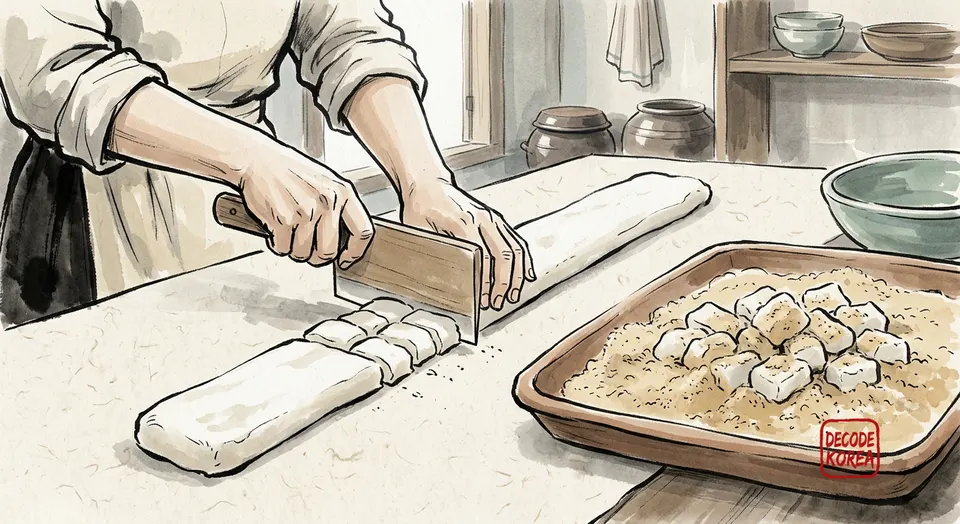
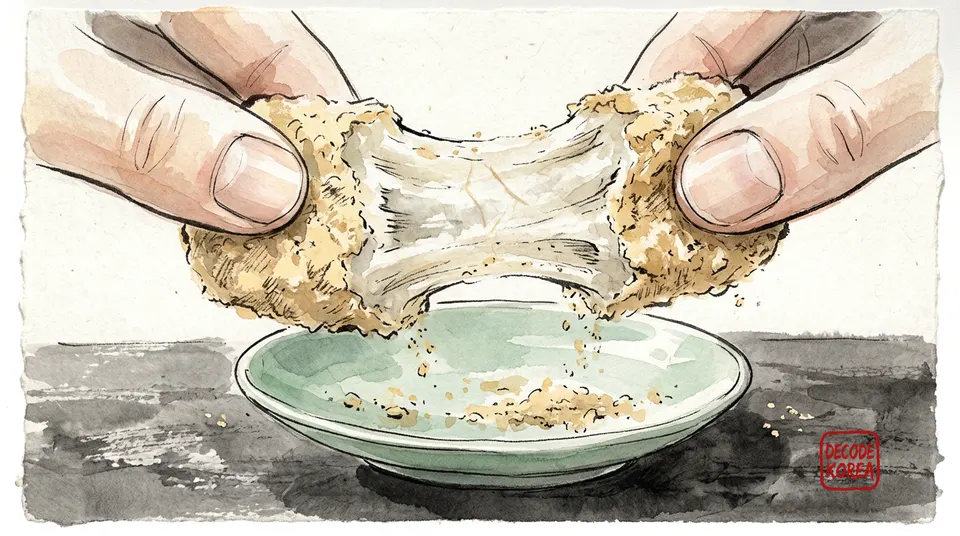
The most helpful visual clue is not color. It is the relationship between pounded rice cake and its coating. A piece of injeolmi can look quiet on the outside because a pale layer of roasted soybean powder softens the surface. The inside, however, belongs to a different sensory register: the pounded rice gives the bite its elastic, cohesive character. Think of the powder and the rice cake as two parts of one form rather than treating the coating as decoration pasted onto a generic sweet.
This is why a process visual can be more honest than a glamour shot. Cutting, coating, and spacing the pieces show how the named form becomes legible without pretending that one illustration documents a particular kitchen. The sources support the bounded explanation of injeolmi within the tteok category; the generated images are only visual prompts. They help you notice texture and sequence, while the institutional records carry the cultural and naming claims.
When you meet injeolmi in a market, display, or conversation, ask what the surface is doing. Is the powder being used to keep pieces separate, add a dry contrast, or identify a familiar presentation? The image alone cannot answer every local question. It can, however, keep you from flattening the form into the vague phrase sweet rice cake.
READ THE FORM
Texture and setting are different clues
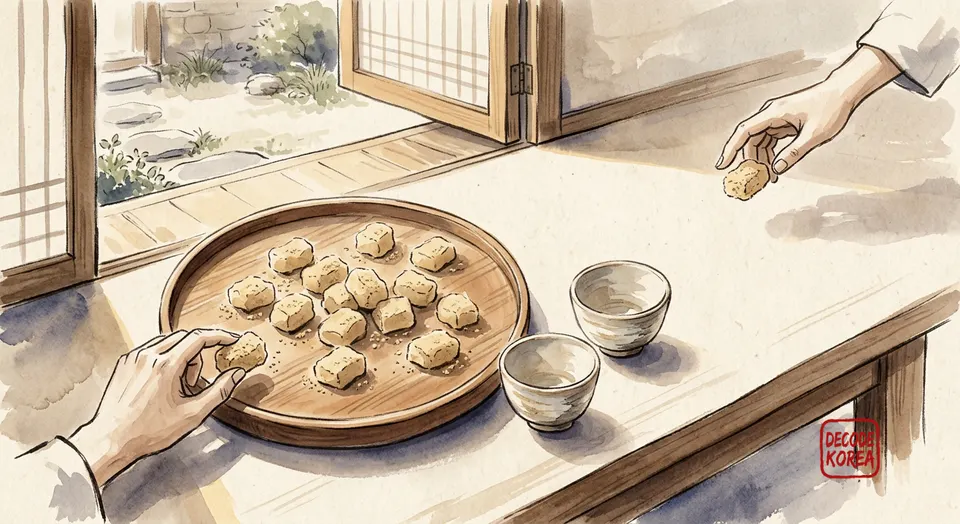
These original editorial illustrations separate the pounded texture, powder coating, and shared-table context so one image does not carry every cultural claim.
1 / 2
Source: 한국민족문화대백과사전 · 인절미 (Injeolmi) · 한국민족문화대백과사전 · 떡 (Tteok) · 한국민족문화대백과사전 · 떡박물관
Treat sharing and occasion as context, not a universal ritual
The word bonding is tempting because a shared tray makes the social dimension easy to imagine. But a careful guide should not turn one arrangement into a rule. The approved records support injeolmi as a named rice-cake form and tteok as a wider cultural category. They do not prove that every serving of injeolmi represents the same family ritual, holiday, or emotional meaning. Sharing can be a useful reading of a setting; it is not a universal translation of the food.
A holiday source can help place food inside a season without defining the food itself. The English Koreanet Chuseok video offers broad holiday orientation, so it works here only as a comparison point for the way occasion can shape how a visitor reads a table. It is not evidence that injeolmi belongs only to Chuseok, nor that a shared tray is a documented ceremony. Keep the holiday cue, the named form, and the specific setting separate.
That separation also leaves room for ordinary use. A piece may be bought as a snack, served at a gathering, shown in a museum context, or discussed as an example of tteok technique. The same word can travel across settings without carrying one fixed emotional message. For a reader, the practical move is simple: notice the occasion that is actually named, then avoid filling the gaps with a story the source does not provide.
 WATCH ON YOUTUBEChuseok, Korean Thanksgiving Day
Open embedded player
Source: YouTube · Koreanet · Chuseok, Korean Thanksgiving Day
Move from the broad category to the specific piece
The broader tteok record gives you the category; the injeolmi record gives you the named instance; the museum record helps you notice how food forms can be preserved and interpreted as culture. Together they create a compact reading method. First identify the umbrella word. Then ask which named form is in front of you. Finally locate the setting: a shop counter, a home table, a seasonal event, a museum display, or an image made for explanation.
This method is also a translation safeguard. Rice cake is not wrong, but it is incomplete when it replaces every Korean term with one English object. Injeolmi keeps information that the shortcut loses: its name, its place inside tteok, its powder-coated surface, and the need to ask about the situation in which it appears. A good translation opens the door; it does not close the conversation.
The same approach works when you compare injeolmi with another named tteok form such as garaetteok. The point is not to rank them or force a complete taxonomy from a few records. The point is to notice that a category can contain named forms with different textures, shapes, and uses. Specific names make better questions possible.
A three-question way to talk about injeolmi
Use three questions when you want to describe injeolmi carefully. What is the Korean name? What texture or coating makes this form recognizable? What setting is actually documented here? The first question prevents the English shortcut from doing too much work. The second keeps the explanation connected to technique and the bite. The third prevents a generated image, a holiday association, or one remembered meal from becoming a universal cultural claim.
You can use the questions at a market, in a Korean restaurant, while reading a museum label, or when explaining the food to someone else. If you do not know the occasion, say that you do not know it. If the shop uses a different coating or shape, describe that variation instead of treating it as a contradiction. If a display gives you a Korean term, preserve the spelling and ask for the specific form rather than settling for rice cake as the final answer.
Injeolmi is therefore both a food and a lesson in cultural reading. The name gives you precision, the texture gives you a sensory clue, and the setting gives you context. Keep those layers together without claiming more than the sources show. That is enough to make a first description clearer, more respectful, and more memorable.
A SIMPLE WAY IN
Name, notice, then locate
Use the same three moves whenever a Korean food translation feels too broad.
- 01
Name
Keep 인절미 and tteok visible before settling for the English shortcut.
- 02
Notice
Look for the pounded texture and powder coating as form clues, not proof of every cultural meaning.
- 03
Locate
Ask what the actual shop, table, display, or season documents before interpreting the occasion.
Source: 한국민족문화대백과사전 · 인절미 (Injeolmi) · 한국민족문화대백과사전 · 떡 (Tteok) · 한국민족문화대백과사전 · 떡박물관