
WAYS TO TRY IT
Choose your way in
Treat the official signal as a reason to observe food in market context, then make the actual food choice from live information.
VISIT IN KOREA
Make a context-first market stop
What decision can I make before arriving?
- START HERE
- Place Gwangjang Market on the itinerary when seeing K-food inside a traditional-market setting is the goal.
- CHECK THIS
- At the market, inspect the current dish, displayed price, queue, portion, ingredients, and seating before ordering; none is established by the tourism statistic.
COOK AT HOME
Carry home the context question, not a copied stall claim
What can I learn without pretending to reproduce a vendor’s food?
- START HERE
- Notice how a market groups preparation, eating, movement, and social space around food.
- CHECK THIS
- Use the market visit as cultural context only; choose any home recipe from separately verified recipe evidence rather than inferring ingredients or technique from this tourism release.
Source: Seoul Metropolitan Government · From K-Food and Beauty to Pop-Ups and Urban Hiking, Seoul Named Global Favorite City for Gen Z and Millennial Travelers for the Fifth Consecutive Year · YouTube · YTN korean · 2026년 8월 2일 K-푸드 세계주방일주 풀영상
Read the 10.4% as a market signal, not a food score
Gwangjang Market has operated on the same downtown Seoul site since 1905, when it opened as Korea’s first permanent market, according to the Korea Tourism Organization’s official visitor guide. That long operating history is the backdrop against which this week’s tourism figure should be read—not a reason to assume the market has stayed the same, but a reminder that its draw predates any single press release.
Seoul’s new release gives Gwangjang Market a specific place in the city’s tourism story. Citing an analysis by the Seoul AI Foundation, it says foreign visitor numbers at the market increased 10.4% year over year in 2025. In the same release, the city describes Gwangjang Market as a destination where visitors can experience K-food and the culture of a traditional Korean market.
Those two points establish relevance. They show that the market is drawing more foreign visitors and that the city presents food and market culture as a combined experience. They do not measure which stall serves the best food, whether a particular dish is available, how long a queue will be, or whether an individual visitor will enjoy the stop.
That boundary makes the statistic more useful, not less. Use it to answer the broad itinerary question: is a traditional-market setting important to how you want to encounter K-food in Seoul? If yes, Gwangjang Market has current official support as a place to consider. Leave the narrower eating decision open until you can see the actual stall.
Split one market visit into two decisions
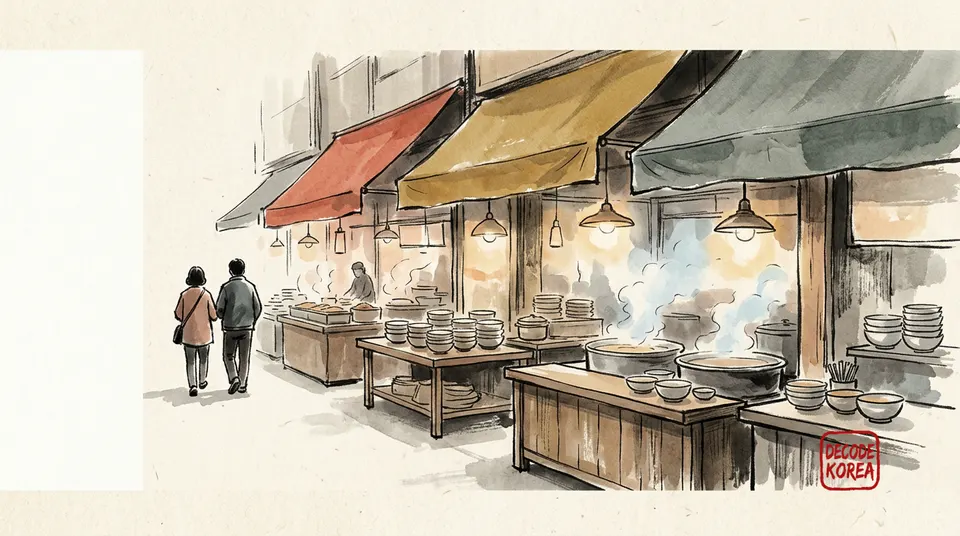
The first decision is about context. A market stop lets you observe food inside a space organized around multiple counters, movement, preparation, and shared public attention. Seoul’s release supports that market-level framing by explicitly joining K-food with traditional-market culture. It does not require you to arrive with a famous-dish checklist.
The second decision happens on site. Look at what is actually being offered, whether the price is displayed, how the queue moves, what portion appears appropriate, and whether ingredients or seating work for you. The approved source bundle contains no item-level market prices, so this guide deliberately provides no budget estimate. A fabricated range would look practical while being unsupported.
Keep the layers separate: the tourism signal gets the market onto your shortlist; live information earns a specific order. That method also protects against a common category error—turning destination popularity into a claim about food quality. Visitor growth is evidence of attention, not a tasting panel.
SEPARATE THE DECISIONS
Market context first, live food choice second
The official signal supports the setting; the stall-level decision still needs current observation.

1 / 2
Use the YTN program as a current attention signal only
YTN Korean published a program titled “K-Food World Kitchen Tour” on August 2, 2026. Its verified publisher, title, date, and description-level record provide a second, current signal that K-food remains an active subject in Korean publisher programming.
The repository record is description-only, not an approved transcript. This article therefore does not attribute a recipe, quote, market scene, ingredient claim, or Gwangjang Market detail to the video. It is evidence of current editorial attention to K-food, nothing more.
This narrow use matters because a video title can tempt a writer to fill in scenes that were never verified. Here the stronger Seoul government source carries the market-specific facts, while the YTN record supports only the broader why-now context.
Run a live check before you order
At a candidate stall, start with four visible questions: what is the item, what is the displayed price, what portion is being served, and what does the queue or seating situation mean for your group? Ask about ingredients when dietary needs matter. None of those answers should be inferred from a citywide tourism release.
If a price is not clear, confirm it before committing. This is especially important because the approved August 14 evidence contains no documented stall prices. The absence of a number is not a hidden recommendation to spend freely; it is a prompt to replace an online assumption with a live check.
You do not need to turn the market into a completion challenge. The useful outcome is a food choice that fits your appetite and constraints while letting you notice the surrounding market culture. One informed order can answer the itinerary question better than a rushed list of supposedly essential stalls.
Look closer
undefined
undefined
- 01
1. Shortlist
Choose the market when K-food in traditional-market context matches your trip goal.
- 02
2. Inspect
Check the actual item, displayed price, portion, queue, ingredients, and seating.
- 03
3. Order
Commit only after the live information fits your needs.
Choose Gwangjang Market for the setting, then choose food on evidence
The newest evidence supports one clear decision: consider Gwangjang Market when you want K-food and traditional-market context in the same Seoul stop. The 10.4% visitor-growth figure shows rising foreign attention, and the city explicitly identifies the market experience as part of Seoul’s lifestyle appeal.
It does not support a best-stall verdict or a fixed spending promise. Arrive with a context goal, inspect the live offer, and make the dish decision from what you can actually verify. That is the difference between using a tourism signal and letting it make an unsupported food claim for you.