Start with a source card, not a vocabulary list
Before you press play, write four labels: 제목 for title, 날짜 for date, 출처 for source, and 한 문장 요약 for a one-sentence summary. The labels turn an open-ended video into a small evidence card. Your first job is not to understand every word. It is to know what you selected and when it was published.
The approved bundle gives you two clearly dated examples: SBS Korean's Korean-language program published August 21, 2026, and Korean Listening Lessons' Korean News video published August 15, 2026. Those records establish publisher, date, language, video format, and news topic. They do not guarantee matching difficulty, complete transcripts, or equivalent editorial standards.
Use four passes and give each pass one job
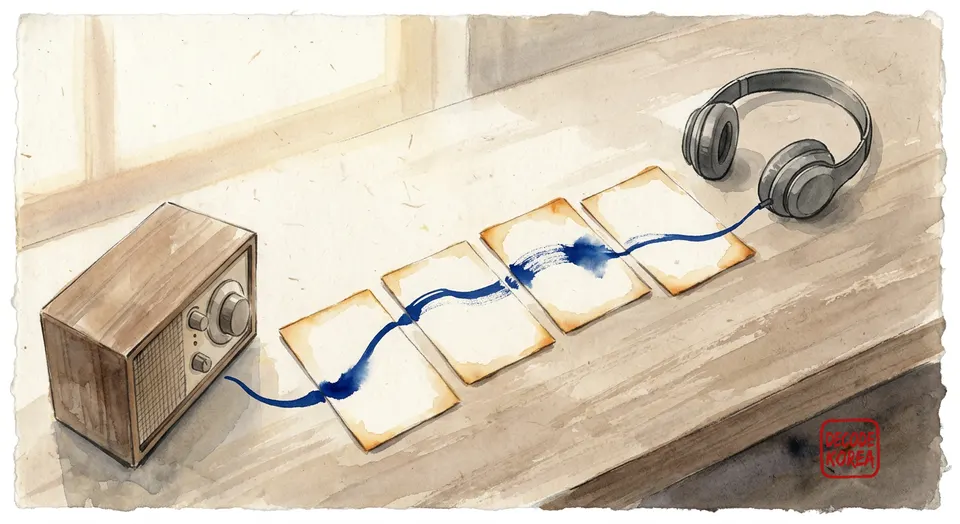
On the first pass, record the publisher and date. On the second, listen from beginning to end for the broad topic; do not pause. On the third, choose three words or short phrases that seem to carry the topic and replay only the surrounding moments. On the fourth, write one gist sentence. Add a question mark beside anything you are not sure about.
The stop rule matters: one card, three anchors, one gist sentence, one uncertainty. A full transcript can be useful later, but producing one is a different task. The SBS record says its transcript is unavailable, while the Korean Listening Lessons record says a transcript is available. The same routine should still produce a finished card in either case.
Look closer
undefined
undefined
- 01
Label
undefined
- 02
Listen
undefined
- 03
Anchor
undefined
- 04
Summarize
undefined
Source: SBS Korean · 2026년 8월 21일 금요일 SBS 한국어 프로그램 · YouTube · Korean Listening Lessons · Korean News 2026/08/15 | Daily Listening Practice
Climb the source ladder only after the first card is complete
Next, compare source types rather than assuming every Korean item does the same job. WorldKorean's July 13 record is a Korean news article about integrated training for Korean-language educators. Jungnang Family Center's July 30 record is a Korean institutional notice for staged Korean education in the 2026 fall term. One is reported context; the other is an operating notice from a local institution.
Use that contrast as a reading and listening check. Can you identify whether an item reports an event, announces a program, or packages news as listening practice? That source-level answer can be reliable even when your sentence-level comprehension remains incomplete.
Keep uncertainty visible instead of translating around it
A good gist sentence can be modest: “This item appears to report a Korean-language education program, but I did not catch who can apply.” The uncertainty mark prevents an inferred detail from quietly becoming a fact. It also gives your next session a precise target.
Compare your second source only after that sentence exists. If the sources agree on a broad topic, note agreement. If their roles differ, note contrast. Do not use one publisher's title or format to fill gaps in another item. Your practice improves when the boundary between heard, read, and inferred stays visible.
Repeat the card tomorrow before adding more material
The next day, replay the same item once before choosing a new one. Rewrite the gist from memory, then compare it with yesterday's card. A clearer sentence or a resolved question is a measurable result; a longer vocabulary list is not automatically better listening.
Keep the archive small enough to review: date, publisher, topic, three anchors, gist, uncertainty. After several cards, sort them by source type or topic. That is when a newsletter prompt or printable worksheet may help—but the routine itself remains free, source-aware, and complete without buying anything.
 WATCH ON YOUTUBEYour Monthly Dose of Korean — Best of July 2026
Open embedded player
Source: YouTube · Learn Korean with KoreanClass101.com · Your Monthly Dose of Korean - Best of July 2026