
WAYS TO TRY IT
Apply the two-speed reading to your own kitchen
Use the comparison-type checklist above whether you're pricing Korean ingredients at your own grocer or planning meals around what's actually expensive right now.
SHOP THE AISLE
Check Korean-ingredient prices with the same rigor
Does this heat wave affect what I pay for Korean groceries outside Korea?
- START HERE
- Check whether your local Korean grocer's spinach, cucumber, or zucchini is imported from Korea or grown domestically before assuming a Korea-specific price spike applies to your store.
- CHECK THIS
- None of these sources report retail prices outside Korea; this article documents Korean domestic price data only.
Source: The Korea Times · Korea's inflation woes grow as heat wave drives up food prices
COOK AT HOME
Swap ingredients if a specific item is genuinely expensive
Should I change what I cook based on this heat-wave price story?
- START HERE
- If you're cooking Korean dishes and a specific vegetable like spinach or zucchini is currently expensive at your source, treat the recipe's vegetable component as flexible rather than fixed.
- CHECK THIS
- This price story concerns Korea's domestic market; it does not establish that any specific ingredient is expensive at your particular grocery store.
Source: The Korea Times · Korea's inflation woes grow as heat wave drives up food prices · Yonhap News Agency · Food prices surge amid unprecedented heat wave
One heat wave, two different speeds
A heat wave doesn't hit every part of the Korean food basket at the same time. Leafy vegetables like spinach and lettuce grow on a short cycle, so a few weeks of extreme heat shows up in the price almost immediately. Livestock and farmed fish work on a longer, more absorbed timeline: animals can die from heat stress over days or weeks, but the supply shortage that raises prices takes longer to reach the shelf.
That difference is why reading a single heat-wave price headline can be misleading. A number reported today might represent a shock that already happened, or one that is still building. Treating both as the same kind of news flattens a story that is actually about timing.
Fast layer: vegetables already show the spike
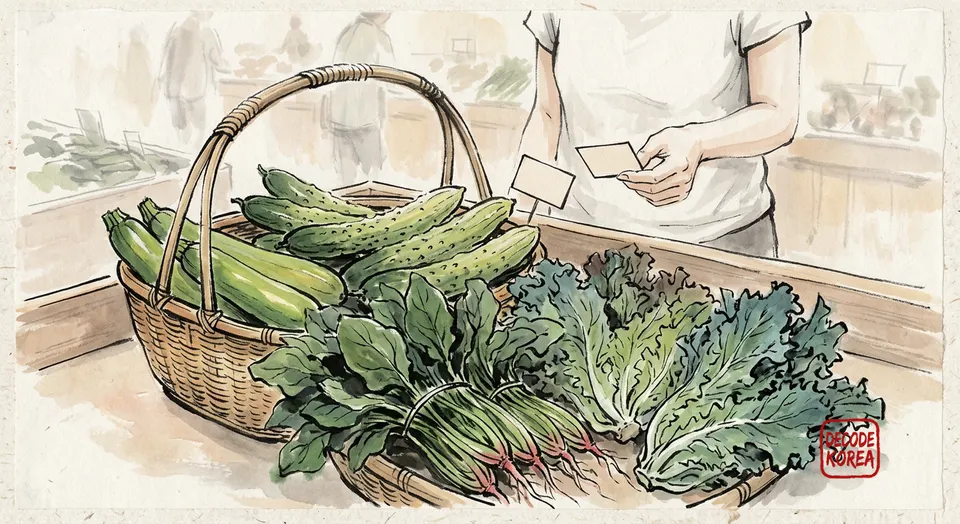
The Korea Times reported that spinach retail prices reached 1,978 won per 100 grams as of August 10, up 152.3% from the same point a month earlier. Cucumber prices climbed 54.8% over the same period, and a single zucchini rose 46.6% to 1,504 won. Yonhap's reporting, citing Korea Agro-Fisheries & Food Trade Corp. data, confirmed the same spinach figure and added that 100 grams of blue lettuce jumped 41.7%.
Both outlets attribute this to the same mechanism: vegetables like spinach, cucumbers, and zucchini grow best in cool temperatures, so their supply drops sharply in extreme summer heat. July's headline inflation fell back into the 2% range for the first time in three months, but core inflation ticked up from 2.5% to 2.6% — its biggest monthly rise since December 2023 — with food prices cited as a visible driver.
Slow layer: livestock and seafood are still catching up
Yonhap reported that a total of 901,602 livestock had died due to the heat wave, 95% of them poultry such as chickens and ducks. At fish farms, 864,497 fish were reported dead from warming water temperatures. These are supply losses, not yet fully realized prices — the animals are gone, but the shortage they create takes time to move through the market.
One concrete example: the average auction price for a kilogram of flounder reached 22,300 won for the week of July 27 to August 1, up 2.29% week over week and 13.2% year over year. An industry watcher quoted by Yonhap said the effect of high water temperatures "has just begun" and expected it to be "most pronounced in September," specifically for flounder and rockfish. In other words: the vegetable shock has already landed, but the livestock and seafood shock is still on its way.
TWO SPEEDS
The basket moves at two different speeds
These original illustrations compare the fast vegetable shock with the slower livestock-and-seafood timeline; they do not depict a specific market, farm, or documented price.

1 / 2
Source: The Korea Times · Korea's inflation woes grow as heat wave drives up food prices · Yonhap News Agency · Food prices surge amid unprecedented heat wave
The twist: below average, but still up from last month
Here's where the story gets more careful. The Ministry of Agriculture, Food and Rural Affairs (MAFRA) published its own early-August price table for major summer vegetables, and by its measure, most of them are still priced below the normal seasonal average (평년, a multi-year baseline), not above it. Napa cabbage wholesale was 32% below that average, radish 31% below, cabbage 43% below, and lettuce roughly flat. Spinach itself was only 0.1% below average at wholesale, even after the reported monthly spike.
This isn't a contradiction between the news outlets and the government — it's two different comparisons answering two different questions. "Up 152.3% from last month" and "below the normal five-year average" can both be true for the same item, because a price can rebound sharply from an unusually low starting point and still land under its typical range. One item did run hotter than usual: perilla leaf wholesale prices were 2.9% above the seasonal average, the one clear exception in MAFRA's table.
Neither comparison is the "real" one. The month-over-month figure tells you about the direction and speed of a recent shock. The seasonal-average figure tells you whether that shock has pushed the price into genuinely unusual territory yet. A complete read of the story needs both.
How to read the next Korean food-price story
When you see a Korean food-price figure — from a news article, a social post, or a market app — check four things before reacting: the specific item and unit (100 grams of spinach is not one head of cabbage), the date the figure was measured, what it's being compared to (last month, last week, last year, or a multi-year average), and whether the source is a news report, a government price table, or an auction record.
For this heat wave specifically, the useful shorthand is: vegetables are the fast layer, already showing up in your grocery bill; livestock and seafood are the slow layer, with the visible damage (animal deaths) reported now but the price effect still building toward a September peak. Whether that overall picture reads as alarming or manageable depends on which of those two comparisons — and which of those two speeds — you're actually looking at.
READ THE FIGURE
Four checks before you react to a price figure
Use this order for any Korean food-price number you see.
- 01
1 · ITEM & UNIT
Confirm the exact item and unit (100g, per head, per kg).
- 02
2 · DATE
Check when the figure was measured, not when it was published.
- 03
3 · COMPARISON
Identify whether it's vs. last month, last year, or a seasonal average.
- 04
4 · SOURCE
Note whether it's a news report, government table, or auction record.
Source: The Korea Times · Korea's inflation woes grow as heat wave drives up food prices · Yonhap News Agency · Food prices surge amid unprecedented heat wave · 농림축산식품부(MAFRA) · 여름철 주요 채소류 수급 동향 및 대응방안